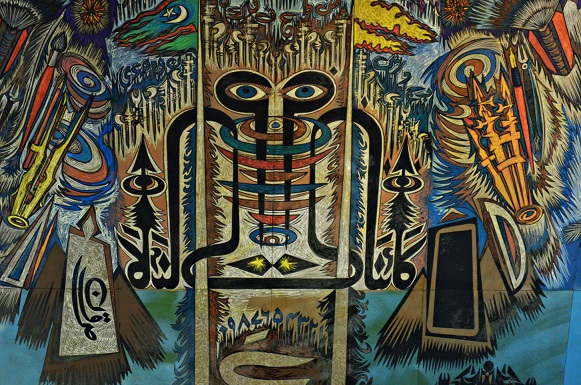
Sadequain stands out as one of the greatest self-taught calligraphers and painters of all time. He was not only a skilled maestro of his craft but his work transcend thought and speak the language of a silent intellectual depth. Born in 1923 in Uttar Pradesh into a lineage steeped into the tradition of calligraphy, it seems it was his destiny to become the master of this art. His full name is Syed Sadequain Ahmed Naqvi, with his each stroke conveyed rich tapestry of thought that evoke emotions that continues to inspire and provoke reflection.
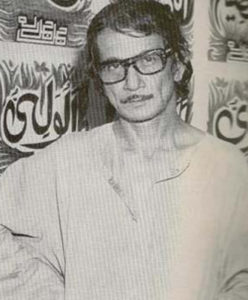
Sadequain’s artistry transcended mere technical prowess; his strength were his deft strokes, keen understanding of composition, and acute awareness of texture. Yet, what truly distinguished him was his remarkable ability to vividly incorporate his surroundings, intellect, and inspirations into his paintings.
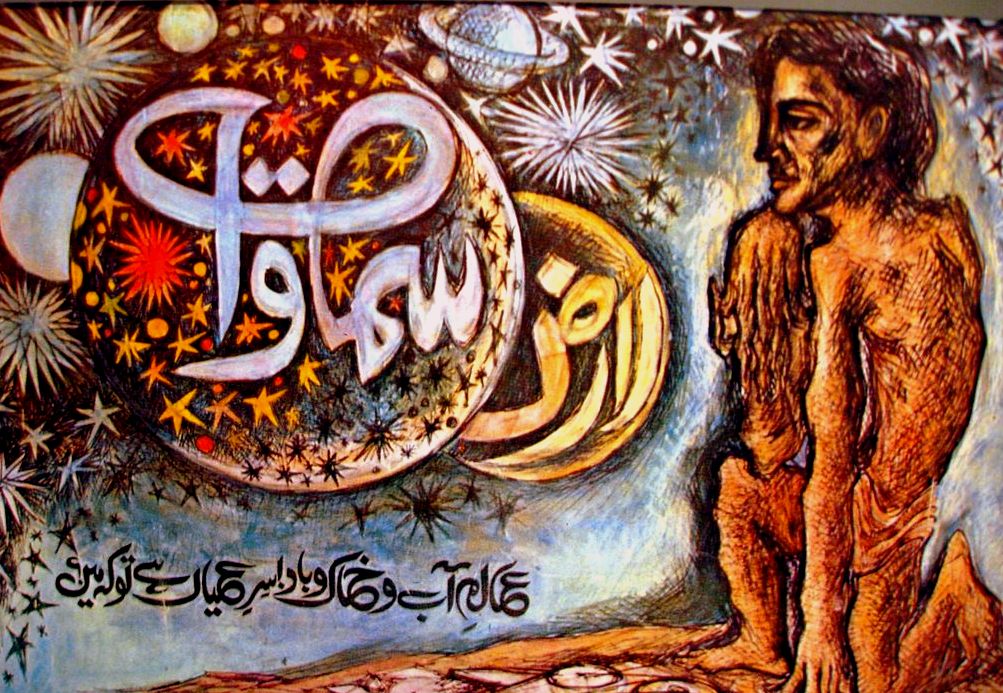
In order to understand Sadequain’s work one must be familiar with rubaiyat and poetry by Iqal, Faiz, and Ghalib. As many of his paintings revolve around the phrases from many aforementioned Muslim poets of subcontinent thus, these paintings could only be encoded by the one who has cultural familiarity as well as inquisitive mind. His murals from Lahore Museum’s ceiling, Wapda House Wall, and Frere House Karachi ceiling speaks of his hidden wisdom behind his master strokes. In his most celebrated murals one can see inclination towards cosmos through the lens of Iqbal, and various other verses and poetry on marifat.
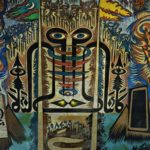
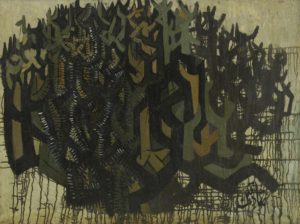
For some time he stayed in remote shores of Gadani in Karachi where he first encountered the plant cactus. He got so inspired by its, shape, form and symbolism that he began to use its form in his later paintings, for him the plant depicted human struggles and sufferings. Since he was a brilliant calligrapher one of his most distinct and original painting inspired by cactus was calligraphy where he integrated the shape of cactus into the Arabic alphabets.
During the 1960s, during a stay in Paris, Sadequain became deeply influenced by Picasso’s style.
While the world has seen many master painters and calligraphers, true greatness lies not merely in skill, but in being skillfully original. Sadequain’s brilliance stemmed from originality—drawing from a wellspring of diverse and unique inspirations. Whether in his bold artworks, where the recurring motif of the cactus is shaped using calligraphic alphabets, the echoes of Picasso’s modernism, or the lyrical depth of Sufi and Urdu poetry, each brushstroke carried a voice uniquely his own.